
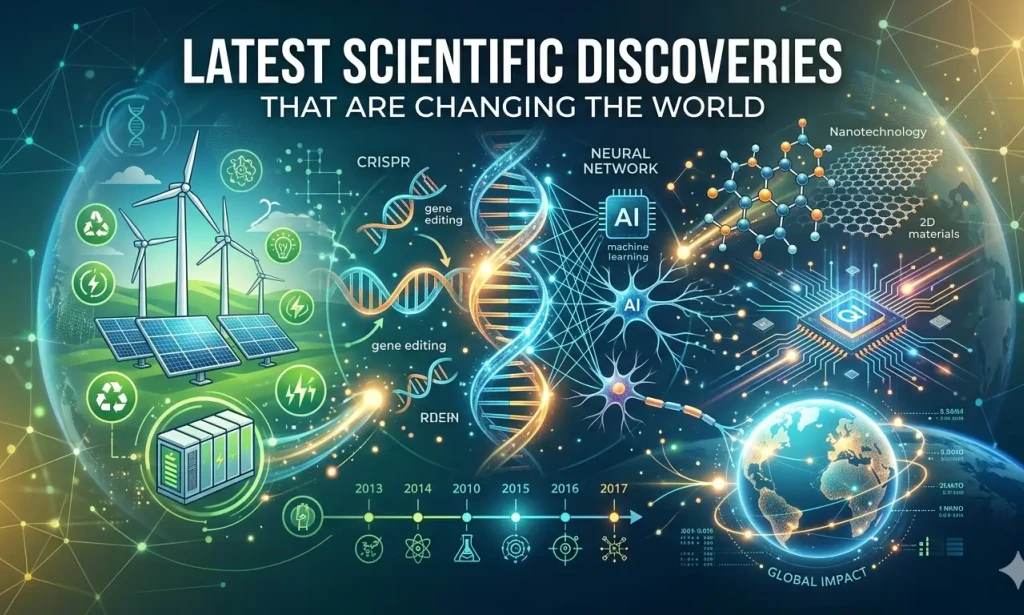
We stand at a remarkable juncture in human history, an era where the pace of scientific discovery is not just accelerating but fundamentally transforming our understanding of life, technology, and our planet.
The latest scientific discoveries are pushing the boundaries of what we once thought possible, ushering in unprecedented advancements across diverse fields.
From revolutionizing healthcare with targeted therapies to unlocking the potential of artificial intelligence and quantum computing, and pioneering sustainable solutions for environmental challenges, we are witnessing a profound shift in our collective capabilities.
This article explores some of the most impactful breakthroughs from 2025 and 2026, highlighting how these innovations are shaping our future.
Revolutionizing Health Through Gene Editing and Advanced Therapies
The medical landscape is being profoundly reshaped by advancements in gene editing and sophisticated therapeutic approaches. These innovations offer new hope for treating previously intractable diseases and are paving the way for highly personalized medicine.
Gene Editing: Precision at the Molecular Level
Gene editing technologies, particularly CRISPR, continue to evolve, moving beyond basic research into clinical applications. A significant breakthrough in early 2026 demonstrated the ability to turn genes on without cutting DNA by removing chemical tags that silence them.
This gentler form of gene editing holds promise for safer treatments for conditions like Sickle Cell disease by reactivating a fetal blood gene, potentially offering powerful therapies with fewer unintended side effects.
In 2025, a landmark achievement involved the first gene-edited baby, KJ Muldoon, who received personalized CRISPR treatment for a rare genetic disease that made protein consumption dangerous.
This bespoke treatment, delivered in vivo to tweak a specific mutation, allowed the editing to take place inside his body, unlike previous methods requiring cell removal and reintroduction.
This success is opening doors for more "N-of-1" therapies, custom-designed for individual patients, with the FDA establishing frameworks to expedite approval for such personalized approaches.
Further advancements include:
-
Bridge recombinases which emerged as a game-changer in gene editing in 2025, capable of inserting large DNA sequences (up to 1 million base pairs) unlike CRISPR's limitations, enabling the insertion of entire gene clusters.
-
Ongoing trials for a CRISPR treatment for high cholesterol and a gene therapy for congenital deafness.
-
Preclinical research is also developing "mutation agnostic" gene-editing systems that could work for a broader range of patients, complementing highly specific mutation-correcting therapies.
Advanced Therapies: Beyond Traditional Medicine
The Cell and Gene Therapy (CGT) sector saw unprecedented growth in 2025, with 1,905 ongoing clinical trials globally.
This surge is driven by advancements in gene editing, RNA therapies, and cell-based approaches targeting a wide array of diseases, from rare genetic disorders to common conditions like cancer and neurological ailments.
Investment in the sector reached $5 billion in the first half of 2025.
Key developments in advanced therapies include:
-
mRNA Technology Expansion: Beyond its pivotal role in COVID-19 vaccines, mRNA technology is now being explored for personalized cancer immunotherapies, treatments for rare genetic disorders, and protein replacement therapies for metabolic diseases. Researchers are even using mRNA to stimulate tissue repair in regenerative medicine and deliver gene-editing tools like CRISPR. The flexibility and speed of mRNA drug design and manufacturing, often in weeks rather than years, make it ideal for personalized medicine.
-
Personalized Cancer Treatment: Innovations like personalized cancer vaccines using mRNA technology aim to reduce recurrence and minimize side effects. Liquid biopsies and AI are enabling early, non-invasive cancer detection and personalized therapy predictions. AI models are also predicting immunotherapy response with 70-80% accuracy, guiding tailored treatments.
-
Cell and Gene Therapy Approvals: In 2025, the FDA cleared Abeona's Zevaskyn, the first cell-based gene therapy for recessive dystrophic epidermolysis bullosa, and Belief BioMed's BBM-H901, an AAV-delivered treatment for hemophilia B, which became the first gene therapy of its kind approved in China. Moderna's mNexspike, a lower-dose COVID-19 mRNA vaccine, also received U.S. approval. As of late 2025, there were 36 approved gene therapies, 71 non-genetically modified cell therapies, and 36 RNA therapies globally, with projections for more approvals in 2026.
Pioneering the Future: AI, Quantum Computing, and Space Exploration
Technological frontiers are expanding at an astonishing rate, with artificial intelligence and quantum computing poised to redefine industries and our understanding of the universe.
Artificial Intelligence: From Assistants to Partners in Discovery
AI is no longer just a tool; it's evolving into a collaborative partner, transforming how we work, create, and solve problems. In 2026, AI is expected to move beyond summarizing papers and answering questions to actively joining the process of discovery in physics, chemistry, and biology, generating hypotheses and controlling scientific experiments.
Key trends and breakthroughs in AI include:
-
Drug Discovery Revolution: AI is reshaping the entire drug discovery process, from identifying disease targets and generating new compounds to predicting safety. In 2025, the FDA released formal guidance on using AI in regulatory submissions, and the first generative-AI drug candidate, rentosertib, entered Phase 2 trials with encouraging early results. The AI-in-drug-discovery market is projected to grow from approximately $2.6 billion in 2025 to $8–20 billion by 2030.
-
Agentic AI: 2026 is seeing a significant shift from simple chatbots to autonomous Agentic AI systems that can plan, initiate, and execute multi-step tasks across different software platforms without human intervention. These AI agents are becoming digital co-workers, handling complex workflows in various sectors.
-
AI in Healthcare Operations: In 2026, more specialized, compact AI models focused on biological and mathematical reasoning are expected to play a more direct role in scientific discovery, screening processes, and solving specific problems with high accuracy. Clinical AI systems are moving beyond the "hype" phase to become reliable tools in diagnosis, clinical decision support, and patient management, integrating deeper into electronic health records.
-
Closing the Performance Gap: Stanford HAI's 2026 AI Index revealed that AI capabilities are accelerating, with coding benchmark scores jumping from 60% to nearly 100% in a single year, and frontier models exceeding 50% on "Humanity's Last Exam" (up from 8.8% in 2025). The US-China model performance gap has effectively closed.
Quantum Computing: Unlocking New Computational Power
The quantum computing industry reached an inflection point in 2025, transitioning from theoretical promise to tangible commercial reality. Billions in investment, government support, and corporate partnerships are driving this transformation.
Significant milestones include:
-
Qubit Scaling: In April 2025, Fujitsu and RIKEN announced a 256-qubit superconducting quantum computer, with plans for a 1,000-qubit machine by 2026. IBM's roadmap includes the Kookaburra processor in 2025 with 1,386 qubits and a multi-chip configuration reaching 4,158 qubits, with a goal to deliver the first fault-tolerant quantum computer by 2029. IonQ aims to push to 256 qubits by 2026.
-
Quantum Advantage: In March 2025, IonQ and Ansys achieved a significant milestone by running a medical device simulation on IonQ's 36-qubit computer that outperformed classical high-performance computing by 12 percent, one of the first documented cases of quantum computing delivering practical advantage in a real-world application. Google also announced the Quantum Echoes algorithm breakthrough, demonstrating verifiable quantum advantage by running an algorithm 13,000 times faster on its Willow chip than on classical supercomputers.
-
Error Correction: Google's Willow chip represents a major advancement in quantum error correction, halving the error rate when scaling from a 3x3 to a 5x5 qubit grid, and again at 7x7. NVIDIA has launched Ising, the world's first open-source AI models specifically designed to accelerate quantum computing by addressing quantum error correction and processor calibration.
-
Hybrid Computing: The rise of hybrid computing, where quantum works alongside AI and supercomputers, is enabling greater accuracy for modeling molecules and materials.
Space Exploration: Expanding Our Cosmic Horizon
While the provided search results did not yield specific "latest scientific discoveries" directly related to space exploration breakthroughs in 2025-2026, the general trend indicates a continued focus on advancing our capabilities for future missions.
This includes developing technologies for deeper space travel, better understanding exoplanets, and preparing for human presence beyond Earth.
We anticipate that ongoing research in AI and quantum computing will eventually contribute significantly to processing vast amounts of astronomical data and designing more efficient spacecraft.
Sustainable Innovations and Environmental Stewardship
In response to pressing global challenges, the latest scientific discoveries are increasingly focused on sustainable innovations and environmental stewardship, offering solutions to mitigate climate change and protect biodiversity.
Renewable Energy and Grid Modernization
The year 2025 saw considerable growth in renewable energy, accounting for 61% of new power-generating capacity in the U.S. Utility-scale solar led with 27 GW alternating current commissioned, and a record 15 GW of utility-scale energy storage was added, a 35% increase year-on-year.
Key advancements include:
-
Grid-Enhancing Technologies (GETs): These are emerging as a fast, cost-effective response to meet expanding renewable power generation and surging electricity demand. GETs include reconductoring, dynamic line rating, advanced power flow control, topology optimization, and storage as transmission.
-
Corporate Demand for Clean Power: Corporate power purchase agreements for zero-carbon electricity reached a record 29.5 GW in 2025, with a growing share of nuclear, hydropower, and geothermal contracts as tech giants prioritize clean, baseload power for AI data centers.
-
Energy Innovation Ecosystem: Over 320 new energy start-ups raised their first funding in 2025, signaling an active ecosystem, though innovators depend on predictable funding and policy frameworks.
Carbon Capture and Circular Economy Solutions
Carbon capture and storage (CCS) is entering a new era, shifting towards integrated progress across the capture, transport, and storage of CO2 in 2026. Previously, segments advanced independently, creating risks and hesitations for investment.
Notable progress includes:
-
Policy and Investment: Germany passed a revised Carbon Dioxide Storage and Transport Act in 2025, enabling commercial-scale CCS and pipelines, including offshore storage. The UK government has allocated £21.7 billion ($28 billion) for CCUS projects. The global carbon capture technology market reached US$ 4.34 billion in 2025 and is expected to reach US$ 8.30 billion by 2035.
-
Technological Advancements: Researchers are developing advanced materials like metal-organic frameworks (MOFs) that can absorb CO2 more selectively and in greater quantities. Engineering improvements are scaling up Direct Air Capture (DAC) systems, with companies running pilot plants capturing tons of CO2 and aiming for megaton scale capture within this decade. Climeworks' "Mammoth" plant in Iceland, operational in 2024, can capture 36,000 tons of CO2 per year.
-
Circular Economy: Automated food waste upcycling, utilizing AI and automation, can reduce methane emissions by diverting food scraps for composting and biogas systems, supporting nutrient cycling and reducing landfill waste. The development of "novel cement-free green concrete technologies" offers an alternative to traditional cement, eliminating emissions and providing a permanent storage route for captured CO2.
-
Biodiversity Conservation: A 2025 "horizon scan" identified several key areas for conservation, including the protection of intact tropical forests and the potential for increased use of GLP-1 mimicking drugs to reduce demand for cropland and pastures, thereby protecting biodiversity. Conservation programs are reporting early signs of ecosystem recovery, particularly in rewilding projects in Europe. Researchers are also studying carbon-capturing fungi networks that naturally absorb and store CO2 in soil.
Frequently Asked Questions (FAQ)
Q: How is AI impacting drug discovery?
A: AI is revolutionizing drug discovery by accelerating target identification, generating novel compounds, predicting safety profiles, and optimizing clinical trials, significantly reducing the time and cost associated with developing new medicines.
Q: What are the latest advancements in gene editing?
A: Recent breakthroughs include the ability to turn genes on without cutting DNA, offering a gentler and potentially safer approach for diseases like Sickle Cell. Personalized CRISPR treatments for rare genetic disorders have also shown success, paving the way for highly individualized therapies.
Q: What is "quantum advantage" in quantum computing?
A: Quantum advantage refers to the point where a quantum computer can perform a specific computation significantly faster or more efficiently than even the most powerful classical supercomputers. Recent milestones in 2025 demonstrated quantum computers outperforming classical systems in medical device simulations and specific algorithms.
Q: How are sustainable innovations addressing climate change?
A: Sustainable innovations are tackling climate change through advancements in renewable energy deployment, grid-enhancing technologies, and sophisticated carbon capture and storage (CCS) solutions. Efforts also include circular economy approaches like automated food waste upcycling and the development of green concrete.
Conclusion: Navigating an Era of Unprecedented Scientific Progress
The latest scientific discoveries are undeniably ushering in an era of unprecedented progress.
From the intricate precision of gene editing and the expansive potential of AI and quantum computing to the urgent and innovative solutions for environmental sustainability, the scientific community is pushing boundaries at an astounding rate.
We are witnessing a future where personalized medicine becomes a reality, computational power unlocks previously unimaginable possibilities, and our relationship with the planet is redefined through ingenious sustainable practices.
As we navigate this period of rapid advancement, continued investment, ethical consideration, and collaborative effort will be paramount to harnessing these discoveries for the benefit of all humanity.

You must be logged in to post a comment.